photo blog header_zps71kqewye.png  photo graze_zps8tw4ef8f.png  photo herd_zpsctgnsufk.png  photo farmstead_zpsmyk28rxe.png  photo faith_zpsyq38oy0o.png  photo general store_zpsr2oehrmb.png
Showing posts with label heifers. Show all posts

working cows

 
Hats (cowboy and otherwise) off to all the men and women working cows on hot days in full sun with no shade: running back and forth, climbing up and down, sweating bullets, wearing hats, swigging water, and doing it all while heifers let off plenty heat of their own. 


And, just in case it needs to be repeated, here's to the generations of farmers working together, regardless of the size of their farm: to the grandmas helping the vet, the dads running the equipment, and the little girls talking non-stop about heifers taking rides to grow big out in Kansas. It's good stuff that goes on here, even when sweat is plentiful and sunburn is inevitable. 

We're grateful. 

happy heifers and apple toffee dip | dairy


We have a routine at our house. Every morning when our little girl wakes up, we go to the window and look for the heifers. If she can't spot them, she cranes her neck to see if they're hiding somewhere. And when she can't find them out one window, she leans toward the other window to see if somehow they're there. 

I mean, they never are. That would mean they are standing smack dab in the middle of the road, and that wouldn't be good for anyone--them or us . . . or the poor Fed-Ex guy who always slows down for our dogs and ends up stopped in the middle of the road honking his horn at them.

radishes


You know those pictures of rows and rows of colorful tulips in Holland? This is like the Missouri version of that. Except it's radishes. 

Confused? Me too. 


Good news! My farmer isn't. 

Me: Can you tell our nice readers what normally grows in this field?
Him while eating popcorn and reading a book on the Texas Rangers: Rye. 
Me: Which is fed to . . . 
Him: Heifers mainly. 

Me: Why do you plant radishes?

Him without looking up: We plant them in the fall for additional grazing for the cows and for soil health. They help the soil by putting down a thick root that breaks up soil compaction. 

Him pausing for a bite of apple: They're also good at gathering nutrients that the next year's crop can use. They are better nutrient scavengers than corn and soybeans. 


Me: Why are they flowering now?

Him:  They didn't die over winter like they normally do because it was pretty mild. Radishes, like lettuce and peas and others, if left to go long enough will flower and bolt and go to seed. We actually don't want them growing in the spring because by the time the rye is ready to chop, they'll be too mature and they won't be as high quality feed. 

Me: But they're so pretty!
Him: Next question. 


Me: Ahem. Right. So what's the purple stuff?
Him: Henbit. It's a weed that grows in late winter and early spring and usually dies off by the time that crops are growing. 

Me: Wait. I wasn't done with the radishes. Why are they the most disliked of the veggie tray?
Him: I don't answer ridiculous questions. 
Me: So . . . we're done here?
Him: *silence*

what we've been up to

January was here and now it's gone. But on the farm, we're still doing what we were doing last month. 


We're kissing a baby, smooching a baby, smiling at a baby, snuggling a baby, staring at a baby . . . all the baby things. 


Meanwhile, the heifers are doing what they were doing in January too: staring down the dogs . . . eating . . . digging the cooler weather . . . 


 . . . running just to run, bellowing at coyotes, behaving themselves for the most part . . . 

but most of all, they're looking forward to spring. And so are we. 


So . . . who's with them?  

I mean, with us?  


coyotes, round 2

I think we all remember the great coyote attack of 2014. (You can read more about it here.) Ok, so it wasn't really so much an attack as it was a potential attack. But you can never be too sure out here. 

It's been all quiet on the Western front until the past couple of weeks when one coyote has started making the rounds again, trotting into the pasture every morning around 9:30 a.m. and trotting back out at about 9:40 a.m. when the heifers realized he was uncomfortably close and charged him. 


A couple of days ago, he upped his game and brought recruits (aka  his siblings) . . . who look strangely similar to the pups who ran up our road last summer. 

In other words . . . they're back! 


This year, however, Petunia and Colt are on it. Usually. 

Petunia spends most of the day sleeping, but Colt lets her know when the intruders arrive. It only takes her a few seconds to snap out of her sleepy haze before she's locked, loaded and on a mission to rid the world of injustice . . . and the pasture of coyotes. 

Can you spot the coyote in the upper right corner? 

Colt is kind of a chicken and won't run out to meet them (or maybe we'll give him the benefit of the doubt and just say that he's more interested in protecting the homestead), but he'll bark, which usually sets Petunia off even more. 


She sprints down the road as fast as she can, makes a hard right into the field entrance and tears across the field after those coyotes who usually make like bandits toward the tree line. 


So far, the coyotes have made it out alive. But I'm waiting for the day when the Colt-Petunia combo hem them in and don't let them off so easy. Or the heifers trample them. Or they just decide their mid-morning jaunt isn't so worth it anymore in this veritable farming minefield. 

Any of those will do. 


babies and mustaches

"Hard work, honesty, integrity, faith, family, love, forgiveness." 

That's what we're about . . . and something tells me, that's true of a lot of other farmers too.


PS Oh yeah, and Baby and my farmer's mustache make appearances too. 

this week in iPhone photos {sept. 21, 2015 and maybe the last couple of weeks too}

This week, we wished it was nap time. Like, every day. Cooler fall weather, lots of sunshine, bellies full of apple fritters from a local apple festival thanks to kind folks . . . and we were ready to nap for DAYS.


But there's a baby on the way, so there's really no time for napping. I'd say there might be time for a snooze or two after baby arrives, but let's not kid ourselves here. 


So instead Chris chopped the second round of silage and I went for long walks in what had been--just days before--a field full of corn. The heifers in the nearby pasture kept their distance. Puppies and loud noises have that effect on these girls. 


We went in for an ultrasound at the crack of dawn and found out that we're having . . . a baby! So that's reassuring. 


I took a little work trip to Washington, D.C., where I sat a lot, let people cart my luggage around, got a nice case of swollen ankles and met the awesomeness that is Drs. Ryan Anderson and Sherif Girgis and caught up with--albeit quickly--Mollie Hemingway and Scott Murray. 

And it was good.  


Chris and the guys rounded out silage season--not without some hilarious exchanges over the radios--and drove the choppers and trucks off into the sunset. And we gave thanks that nobody tipped a truck over or backed into each other or drove over the chopper. It's the little things. 


The puppies learned how to bark and howl at nearby neighbor dogs, and yet they still choose to stick together like the Three Musketeers instead of meeting their brother, whose bark from the neighbor's house stopped them all in their tracks.

Literally.


To top it off, Winchester christened the new feed truck by sniffing it, surveying it and curling up next to it . . . for a nap. 


And now, since we've come full circle--all the way back to naps and just the way we like it--I think we're done here.  


raspberry jam AKA Chris's miracle jam

My poor husband made the mistake of coming home for lunch the day I attempted to can jam for the first time in roughly 15 years. He walked in the door to a wife who couldn’t figure out how to convert liquid pectin to powdered pectin.

It wasn’t pretty. And the kitchen was HOT. And I'm pretty sure I was sweating. And definitely pregnant. And hangry. 

Jars bounced in boiling water on the stove. Raspberries and lemon juice and sugar were fast approaching a rolling boil.

And I, queen of cheating at math in grade school, was trying to figure out how to make the pectin sitch work with mere moments to spare.


Of course, HE had just repaired a broken air conditioner at a rental house, taken care of heifers who’d escaped their pen, pulled a calf and . . . well, the list goes on.

So when I, practically in meltdown mode, asked for his help, he figured it out for me, even though he had a million other things on his mind.


Because he is just that good.

He also saved the jam because left to my own devices, I would have just started dumping pectin in and hoped for the best. 

So, in honor of the one who can actually do things with numbers, who dairies and farms and converts recipes in the blink of an eye, I'm renaming this  "Chris's Miracle Jam," because he saved it from sure and sudden demise in a hot kitchen on a sweltering day from a hungry wife who just can't do math. 

Raspberry Jam

3 1/2 cups crushed raspberries
1/4 cup lemon juice
7 cups sugar
1/2 tsp. butter or margarine
1 3-oz pouch liquid pectin

Prepare boiling water canner. Heat jars in simmer water until ready for use. Do not boil. Wash lids in warm soapy water. 

Combine prepared berries with lemon juice and sugar in a saucepan. Add up to 1/2 tsp. butter to reduce foaming, if desired. Bring mixture to a full rolling boil that cannot be stirred down, over high heat, stirring frequently. 

Add pectin, immediately squeezing entire contents from pouch. Continue hard boil for 1 minute, stirring constantly. Remove from heat. Skim foam if necessary. 

Ladle hot jam into hot jar, leaving 1/4 inch head space. Wipe rim. Center lid on jar. Apply band until fit is fingertip tight. 

Process jars boiling canner for 10 minutes. Remove jars and cool. Check lids for seal after 24 hours. 


real things

When I lived in St. Louis, my morning consisted of a twenty-minute commute through eight lanes of traffic. After I learned that the key to city driving is to drive about 10 times more aggressively than you're comfortable with and to realize that you might, at any point in time, be squished to death on the highway like a sardine between two semis, it wasn't so bad. 


But it is nothing . . . NOTHING . . . compared to mornings in the country. 


Fog. Sleepy cows. Barking dogs. Chickens putting up a fuss. Pick-ups  with farmers at the wheel, taking their time checking out the fields while finishing their first cup of coffee. 

Sign me up. 


If the sound of horns and sirens, squealing tires and doors slamming have got you down, find yourself a spot in the country. Stay a day or two. But if you can, wake up early. 

Nothing compares to laying in bed, with the windows open and a cool breeze blowing in, and slowly waking up to the sound of birds or, sometimes, to the sound of nothing at all. 


"The real things haven’t changed. It is still best to be honest and truthful; to make the most of what we have; to be happy with simple pleasures; and have courage when things go wrong.” - Laura Ingalls Wilder 


awkward teenage chickens

Remember those cute, yellow, fluffy, little balls of chickens that we picked up at the post office just a couple of weeks ago? They've now successfully entered their awkward teenage phase of life where their legs are too long, their feathers aren't full and they want to fly but can't really figure out how.


"call the calves" contest

It doesn't matter how big or how little a child is, how much they love animals or if they're terrified of them. Every kiddo that visits the dairy, somewhere between the calves and the mamas, asks the question: "Do the cows have names?"
They do. 
It's just that their name is actually a number. 
And sometimes those numbers show up in church bulletins and cause quite a bit of confusion for farmers who can't remember if they're supposed to be looking up a hymn or remembering how many pounds of milk that cow gives.
#farmerproblems
But every now and then a pig or a cow comes along, with special markings or a unique personality, one that--if you'll pardon the expression--stands out from the herd, just begging to be named. 

Are you my mother?

Saturday mornings are my favorite. Monday through Friday mornings involve getting ready for work. Sunday morning involves getting ready for church. But Saturday morning means getting to putter around the house with the windows open, listening to heifers wolf down grass and waving at the occasional neighbor who drives past. 

no good reason

Chris and I have an ongoing battle over how many heifers ought to be grazing the pasture in front of, to the side of, and behind our house. 
Ok, so it's not really a battle. 
It actually goes like this.
Him: I'm taking 20 heifers out of the pasture and back to the dairy today.
Me: Nooooo!
Him: ??
Me: Who's supposed to keep me company out here?
Him: There's still 20 in the pasture.
Me: But . . . but . . . 
So last week, when he said, "I'm taking 20 heifers out of the pasture," and my mouth started to form the word, "Nooooooo!" he quickly interjected, "But I'm bringing 40 more back."
That's more like it. 
A man after my own heart. 
He showed up after lunch with a trailer, the same trailer--I might add--that carted all of my Pyrex and scrapbooking stuff and clothes from the city to the farm.
We're dual purpose people 'round here.

And then the cows started walking out. 
Walking. 
Taking their sweet time.
{I would like to take this moment to address a certain video that's made its way around the Internet. It's the one with the title about cows frolicking in the pasture after being penned up all winter, and when you watch it, you see cows kicking up their heels and jumping over daffodils and seemingly enjoying life to the fullest. You know the one.} 

I (actually don't) regret to inform you that cows kick up their heels and jump over daffodils and seem to enjoy life to the fullest even when they have been in the pasture all winter. 
They do it all the time. 
And for no reason. 
Watch them long enough, and you'll see one cow decide to start running. And then all her friends decide to start running too. 
And even though there's no good reason, they all join in. 
"Look at us! We're running! We are so running!"
Then the leader stops. And so they all stop. 
For no good reason. 
Herd mentality, meet your definition. 

Side note: America, meet your dairy farmers. 
Or farmer. 
Really the best dairy farmer, in my opinion. 
I'm definitely biased, but I'm pretty sure I'm not wrong on this one.

Once the heifers were out of the trailer, they walked away and got busy eating. 
And sniffing.
But mostly eating. 

Then they headed off over the hill to do a little exploring. 
What they didn't know was that there was another small herd on the other side of the hill. 
That's when the REAL frolicking began. 
And by "frolicking" I mean, the two herds ran at each other, skidded to a stop, stared at each other like the bovine version of the Hatfields and the McCoys and then went back to eating. 
It was pretty anticlimactic for those of us watching. 
Ok, for me.

Then Chris loaded up another trailer of heifers and took them to a different spot in the pasture. 
The spot by that gate that I drove past in the dark. 
You know the one. 

While he wrote down some of the cows' numbers, I took pictures of grass because hey, it's spring and I'm just glad it's not snow. 

Then the girls sauntered off the trailer,

saw their friends, and were off to the races. 
Or just to the side of the hill to see what all those trees were about. 
Hey, it's the little things in life. No one said they had to have a reason.


10 minutes with a dairy farmer

On our way to visit family in Illinois this weekend, I devised a great plan. "You're driving! I'm just sitting here! We should write a blog post!" I exclaimed to Chris. "Umm, gosh. We're going through St. Louis. Look at all this, you know, traffic and stuff," he said. Undeterred, I pushed forward. The following resulted. 
Well, not the calf, but the interview. 


AH:      People probably wonder what a day in the life of a dairy farmer looks like. So, what's a day in the life of a dairy farmer look like?
CH:      I start by working on heat detection in the AI pens.
AH:      I have no idea what that means. You wanna check the heat? Why not just look at the thermostat?
CH:      Umm…….
AH:      But seriously.
CH:      Let's start at the beginning. AI stands for artificial insemination.
AH:      Not artificial intelligence?
CH:      *ignoring AH* We as dairy farmers don’t have any magical way of knowing when a cow's in heat and is ready to breed so we look for certain signs. I could go into detail about those signs, but we’ll save that for another day.
            When we find the cows that are in heat, we prepare semen. It’s frozen in tiny little straws. We thaw it out, and we use that semen to breed the cows. 
AH:      *in my best three-year-old voice* But whyyyyy?
CH:       There are several reasons for this:  (1) Safety. Dairy bulls are very dangerous, and every dairy farmer knows someone who’s been injured or killed by a bull. (2) By AIing, you get access to higher quality bulls and thus higher quality genetics.  Some bulls have better genes for milking, just like some families have better genes for running, for example. Sidenote: This has nothing to do with GMOs; genetically modified livestock isn’t a thing. It doesn’t exist. We do use bulls on the farm in certain situations, but we try to minimize the amount we have to use them for our safety as well as for the overall genetic quality of the herd.
AH:      Then what do you do? Also, I’m hungry.
CH:      Have a carrot.  Well, I check with different people on different projects, make sure everyone’s got work for the day, that they’re pointed in the right direction. Then I start looking over the milk data and the calving data from the previous day and look for anything that stands out.
AH:      What’s Blackjack the dog doing while this is happening?
CH:      He’s pouncing in piles of manure, playing tug of war with cow tales, digging in my trash can, licking snot off of cows's noses, and generally wreaking havoc. And chasing cats. Basically, it’s a dog’s wildest dream come true.
AH:      What else?
CH:      The next routine thing that’s done every day is checking our hospital pen and our post-fresh pen. When a cow has a calf, she’s said to freshen. A post-fresh pen is filled with cows who have calved in the past two weeks. They get their own pen with more space and more feed and more care. The vast majority of health problems will occur within two weeks of calving, so we look at this group of cows in extreme detail every day. We look at how much milk each cow produces. We look at each cow's body temperature, their manure, how bright their eyes are and how perky their ears are. We look at how much they’re eating and their overall appearance, and we do this for each cow every day for the first couple of weeks. Prevention is key in all of this! We would rather prevent problems early on rather than let them develop.
           The hospital pen is for any cow that has gotten sick and has been treated with antibiotics. The reason these cows are kept separate is because their milk cannot be sold and cannot enter the market for human consumption. Once the cows have gotten better and they’ve not been treated for a set amount of time (ranging from several days to several weeks depending on the type of medication and how quickly it leaves their system), we test their milk for antibiotics, and if the milk tests negative, they re-join the herd. If it tests positive, they have to stay in the hospital pen until all the antibiotics are out of their system.
AH:      Sometimes you get called away from what you're doing to pull a calf. Why’s that?
CH:      When cows are having their second, third, fourth calf, 90 percent of the time, they have it on their own with no problem. When they have their first calf, they need help about a 1/3 of the time. So when we do need to help, either the cow isn’t able to push the calf out on her own and she needs assistance, or the calf is presenting incorrectly, which means the calf is coming out backwards or upside down. At that point, I help to rearrange the calf and help it out.  My job is to make sure mother and calf are both alive and well by the end of the calving process.
AH:      So you’re like a cow ER doctor.
CH:      Sure.
AH:      What’s your favorite part of your day?
CH:      Coming home and kissing my wife.
AH:      Awwwww, honey. Ok, favorite part of your day on the DAIRY.
CH:      A large part of what we do is prevention. We try to prevent problems before they happen. Rather than treating a cow when she gets sick, we’d like to prevent her from getting sick in the first place. Rather than pulling a calf, we’d rather do things earlier to prevent the calf from needing to be pulled. So for me, herd management is my favorite part of the job, and prevention is a key part of that. I like preventing problems so that the farm runs smoothly.
AH:      What’s the messiest job you’ve ever had to do on the dairy?
CH:      Crawling through a tunnel filled with mud and muck to fix a broken pipe. Being shoulder deep inside a cow trying to help a calf come out correctly while being soaked in blood, amniotic fluid, and manure. Riding a four-wheeler in freezing rain, trying to get cattle in after they just tore down a fence. Want me to keep going?
AH:      I think I'd rather not know. Final question: As a sixth generation farmer, what do you think your ancestors would think of what you’re doing today?

CH:      They’d be blown away by the efficiency that dairies today are able to achieve. They would see the technology that we’re able to use, and they’d be astounded. They would see how closely we’re able to monitor and care for our cows, and they’d be impressed. They’d see the quality of feed and the quality of cattle we have, and they’d be jealous. And I think they’d see our family, and they’d be proud.

outside looking in

My husband sang a solo in church tonight. For a job well done, I told him I'd treat him to Sonic on the way home.
And me too.
But, you know, mostly him.
For singing and all.
Just as we got to the car, the phone rang. It was one of the dairy employees. A heifer was giving birth, and the calf was coming out all catywompus. The employee couldn't get to the calf to help straighten it out because the heifer wouldn't stand. There was no room. (Chris here.  When a heifer is laying down and having a calf that is presenting incorrectly, everything is squished together and there is no room to move the calf into the correct position.  You have to get her to stand somehow.  Or they both die.) He questioned what else he could do.
Chris told the young man he'd be there as soon as he could, and while I shrieked that we didn't need ice cream anymore and that he should GO GO GO, he still managed to whiz through the McDonalds drive-thru and scarf down a McFlurry while speeding home to change into work clothes.
While we drove, another dairy employee texted. "We need you to show us how to do this."
A few minutes later, "Should we hoist her up? How do we get her to stand?"
It was 9:00 p.m. by now. Our gravel roads were dark as Chris sped toward the dairy. He was quiet, and I could see the scenarios for this difficult birth running through his mind.
We pulled up to bedded pack, a pen layered thick with straw. The heifer was up by now, hoisted gently so that Chris could get to her calf. Three employees were gathered around her, long-sleeve shirts and vests, jeans and muck boots, ready to do what they could to assist but unsure of how to proceed.
I got out of the truck and watched Chris pull his shoulder-length glove on.
The heifer was clearly in pain; I imagine any mother can commiserate. Her baby wasn't coming out the way it was supposed to, and she had been laboring long enough to know something wasn't right.
Her bellows and groans were deep. Her stomach tightened and untightened with contractions. If anything reminds you of the curse of Genesis 3, it's watching an animal that weighs well over a thousand pounds moan in the pangs of childbirth.
The three men gathered around Chris, arms extended, ready to jump in when or if he needed them to help.
I watched him work, straightening the calf out so that it could be delivered in a way that wouldn't hurt the mother any more than she already was.

The calf came out, bloody and wet, and one of the men immediately started rubbing him down to help get him breathing.
Another moved to assist the mother while Chris went to grab some painkillers (Chris here.  And antibiotics.  Because I care enough about my animals to give them antibiotics in special circumstances.  Usually having a calf doesn't require antibiotics.  But when I have to stick my entire arm and shoulder into her vagina in an effort to get the calf presenting correctly, I'm going to give the poor girl some antibiotics.  And as always, when cows get antibiotics, their milk gets dumped for a week or two until all the antibiotics are out of her system and the milk test shows that she's clean.) to take the edge off of what had undoubtedly been a tremendously painful birth.

It hit me then as I watched these four grown men form a circle around one mama Holstein, and I got a little teary, proud to be the wife of a dairyman and thankful to be the daughter of a pork producer.
I know that if an animal rights group had taken a picture right then, the caption would have been very different. "Dairy employee wrenches defenseless calf from wailing mother," it would have said.
But I saw something very different. It was late. All four men were tired. It was dark outside. Undoubtedly they would rather have been home with their families.
But there they were, out of bed, out in the cold, out in the middle of the night to help this little mama bring her first calf into the world.  They were all smiling when it was over, relieved but mostly happy that the calf was alive and that the heifer was on her feet.
Chris jumped back in the pickup with a smile on his face. "Calf's alive. Mama's up. It's a good night," he said.
The other three men dispersed soon too, one to go back to hauling manure in the dark, another to milk, and one home to bed.
Two will be up and at the dairy again in eight hours. Two more will be there soon after.
Farming isn't easy. It isn't pretty. It isn't glamorous.
But it is immensely rewarding . . . even when you're just the wife . . . on the outside looking in.

a merry dairy Advent


One good thing about Advent: It's the time of year in which the Lord causes us to hold up, slow down, and just chill out while we wait for His return. 
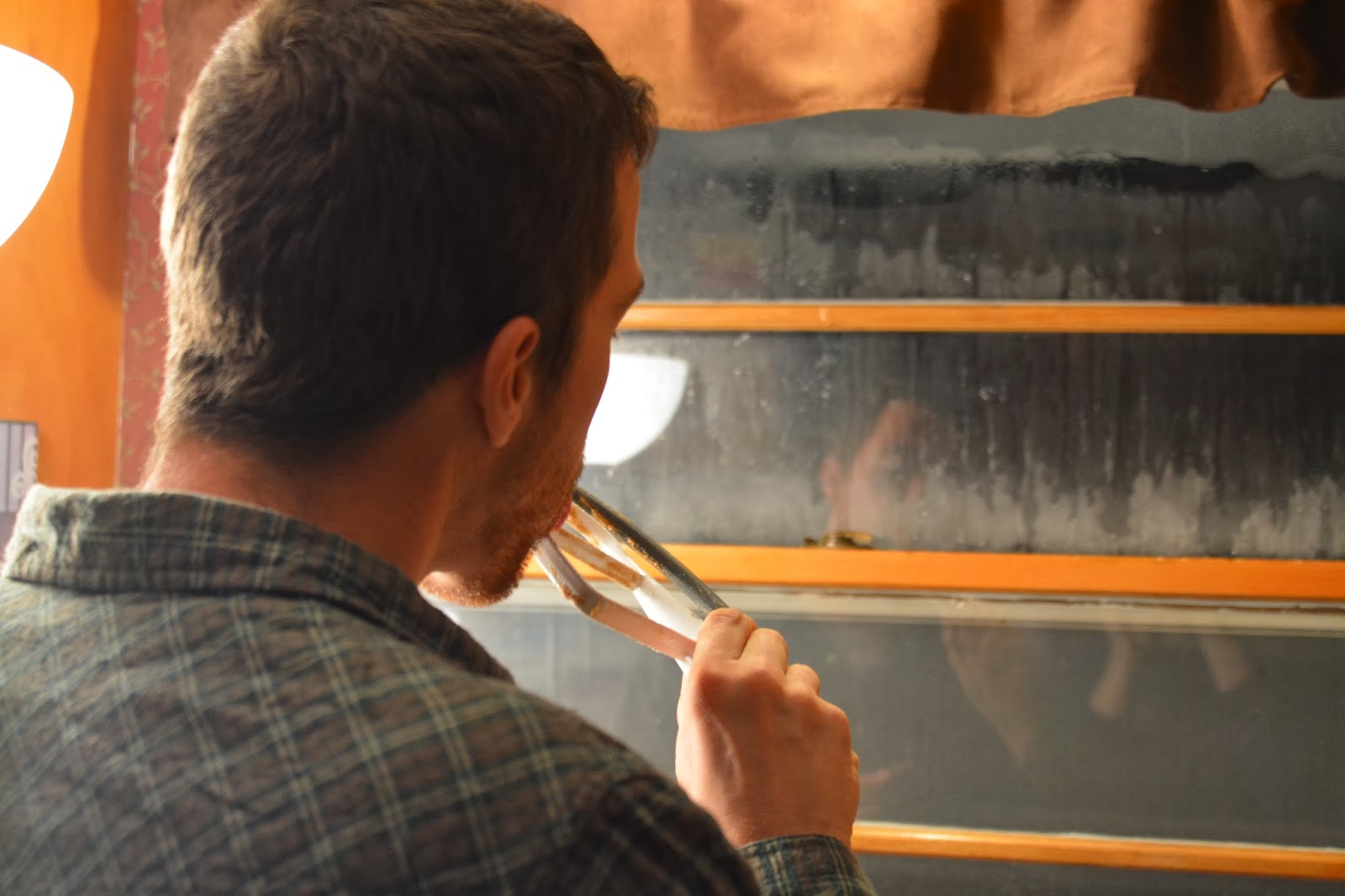
First step: Hand model for Zinpro. Next step: Ruggedly handsome action shots for his very own cooking show. 
It's also the time of year that we bake cookies. 
Lots of cookies. 
With butter. 

Hey, we're dairy people after all. 
The only thing that could make those cookies better is a big topping of bacon bits. 
Basically a whole hog. 
The third best thing is if you lick the cookie batter off the mixer paddle while thinking your wife won't catch you. 
And the good stuff just doesn't stop!
There's pizzelles . . . made with butter. 
And apple-walnut-granola cookies . . . made with butter. 
And snickerdoodles . . . made with, well, I think you get the idea.  
And to top it off, my friends Sarah and Martha showed up to decorate sugar cookies that have, um, well, don't judge us. 
We have to support our industry. 
And to be fair, who can resist them?
Especially when Sarah, who made her first visit to a dairy farm, converted a horse cookie into . . . a Holstein! 
Or Holstein-ish. 
Umm, Holstein-esque? 
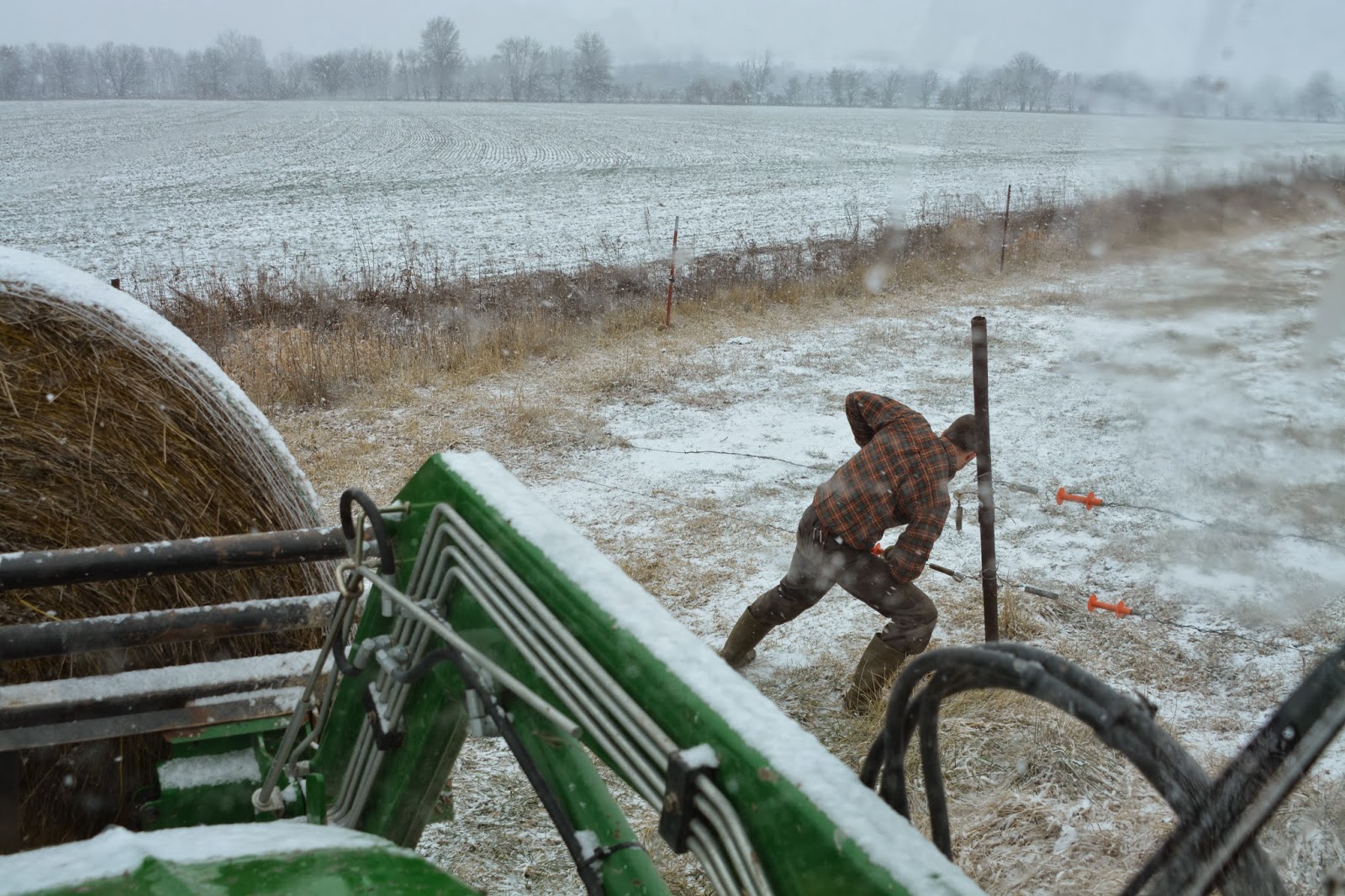
Speaking of Holsteins, neither rain nor sleet nor snow nor hail keeps a dairy farmer from making sure his cows are fed, even on snowy Sunday afternoons. 
Cows are very grateful for this. 
You can't see their gratitude, but we know it's there.  
While I was chillaxing nice and toasty in the cab, this guy was out cutting the net wrap off the bale. 
It's kind of like a magic trick. 
First he's here. 
Then he's there. 
The man's like a Flying Walenda walking a tightrope, I tell you! 
And while he did, the heifers were very patient. 
Just kidding. 
They were swarming him like a dairy farmer's wife making cookies with butter. 


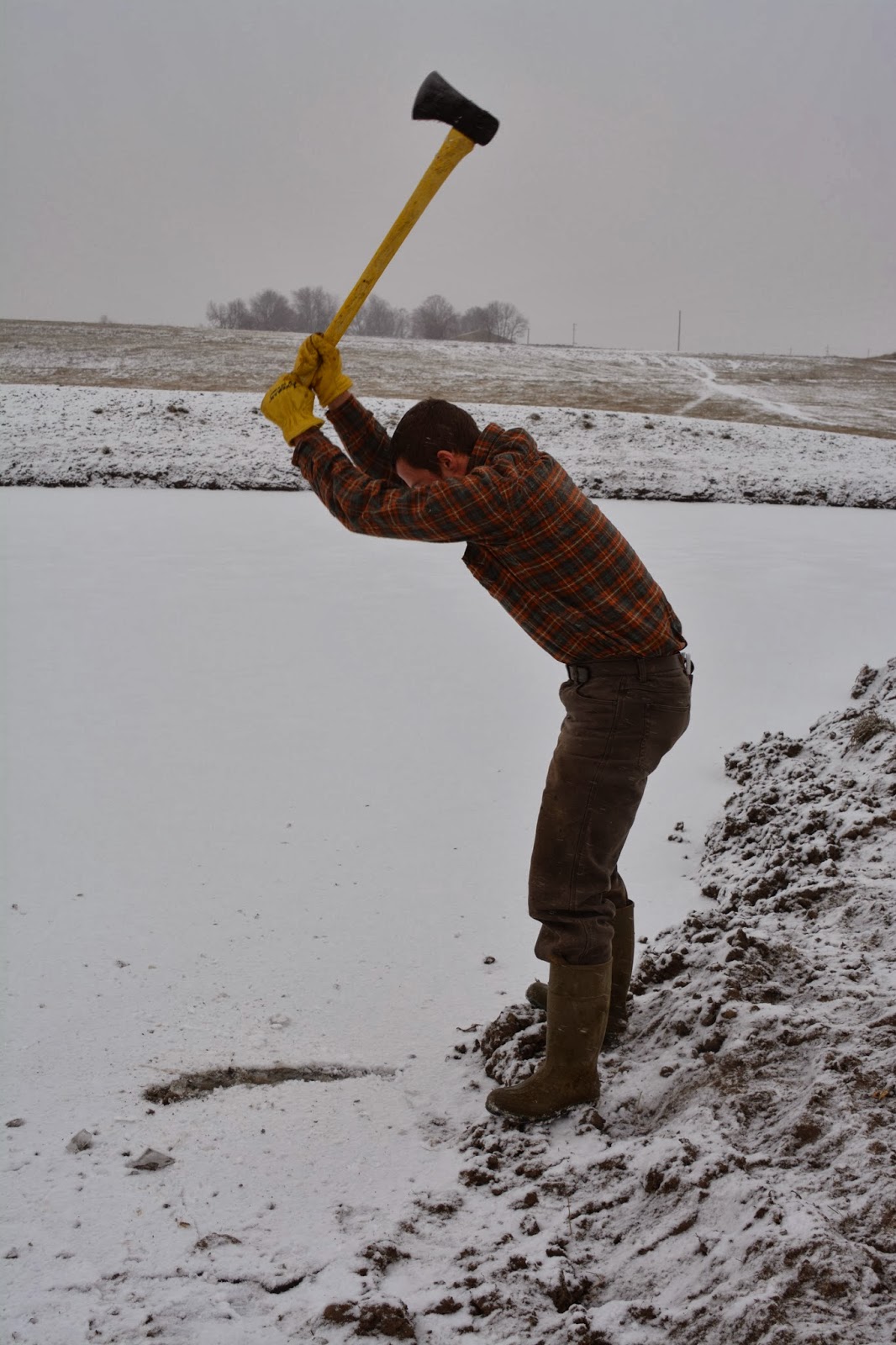
Cows like water too, so while I delicately hop-skipped over the electric fence, my guy was already down at the water, hacking away at it like a lumberjack. 
(Also, if you scroll this super fast, you get your own little digital flip book.)
Ready. 
Set. 
Go.


HI--YAHH!


The victor gets the spoils, 
heaves it across the pond in a feat of strength,  
drops his wife off in his luxurious ride, 
and heads off to do the same thing for the next set of cows . . . 
while his wife, fixated on the next opportunity to indulge in butter, cookies, and milk freaks out at the sight of a coyote eyeing the cows. 

Yes, Advent has been very good to us indeed. 

Blogging tips