photo blog header_zps71kqewye.png  photo graze_zps8tw4ef8f.png  photo herd_zpsctgnsufk.png  photo farmstead_zpsmyk28rxe.png  photo faith_zpsyq38oy0o.png  photo general store_zpsr2oehrmb.png
Showing posts with label dairy. Show all posts

Rhubarb Cherry Crunch


Regrettably, due to youth and naivete, I spent a large portion of my childhood saying, "No, thank you" when my mom offered rhubarb cherry crunch for dessert. This is a poor decision I'll have to live with for my entire life.

You, on the other hand, still have a chance to live your best rhubarb life starting here and now.

Just don't add the walnuts to the crumble. I mean, you CAN . . . if you're a squirrel or a chipmunk or some other kind of rodent who enjoys eating things that taste like tree bark. But if you're none of those things and can still dig walnuts and voluntarily wreck a perfectly good dessert by smothering the rhubarb and cherry deliciousness in them, we may never be able to see eye to eye. Or I may just encourage you to go to a doctor. It could go either way.

Regardless, try this dessert warm with a little milk poured over the top. It may not be the normal way to eat it, but it's the Iowa way, which clearly makes it the best way. Enjoy!


4 c. rhubarb
1/2 c. sugar
2 T. cornstarch
1 c. water
1 jar cherry pie filling
1 tsp. almond extract
3/4 c. oats
3/4 c. brown sugar, packed
3/4 c. sifted flour
pinch of salt
1/3 c. butter
1/2 c. walnuts

Place rhubarb in 11x7x1 1/2" baking dish. Combine sugar and cornstarch in small saucepan. Gradually stir in water. Cook, stirring constantly, over medium heat until thick. Stir in pie filling and extract. Combine oats, brown sugar, flour, salt, and butter until crumbly. Add walnuts. Sprinkle over fruit. Bake at 350 for 45 minutes or until golden brown.

dairy / COVID-19 interview round-up


Dairy farmers have been in the news lately, discussing the issue of, in some places, an oversupply of milk. Exports, restaurants, and schools are shut down and are no longer receiving regular shipments of dairy products. Unprocessed milk can't legally just be given away, and food pantries and food banks aren't set up to receive thousands of gallons of milk anyway. Cold storage is full. So, for some farmers, milk has simply had to go down the drain.

It's hard to get the full story in a brief news segment, but my farmer is doing his best to set the record straight about why it's happening, what people can do in the meantime, and -- the part that often gets left out -- that farmers have known hardship before, dug in, found a solution, and weathered the storm. And the good news? They'll do it again! 

Check out the links below from this past week to see/hear him chat about dairying during corona. (Not to be confused with dairying WITH a Corona, which is probably what most farmers would like to be doing right now.)

KMBC: "For a cow, once you stop milking her there is no restarting." Her milking, that is. Exports, restaurants, schools and the economy, for sure . . . and hopefully soon!

KFUO: You can listen to my farmer and me chat about the vocation of dairy farmer and how COVID-19 has impacted how we're taking care of our team, cows, and neighbors during this time.

FOX 4: "Eat that extra ice cream. Put that extra slice of cheese on your hamburger." Wise words from my husband for any day of the week, but now especially!

KCTV5: Rather than assume that farmers would rather dump milk than give it away, my farmer's encouraging people to learn the facts. "Just assume everyone is doing their best and working to beat this thing."

How Coronavirus Is Impacting Farm Life


Between spring rains, preparing for planting, and keeping an eye on how COVID-19 is changing pretty much everything for everyone from one day to the next, I nabbed my favorite dairy farmer and asked him to help you take a peek into how the coronavirus situation is impacting dairy farming.

Q: How has the coronavirus pandemic changed daily life for you on the farm?
A: If there's ever a "good" time of year for a situation like this, it's now. It's come at a time of year when we're preparing for planting, but since it's been wet and we can't get into the field, we've had the necessary time to be in the office researching and preparing contingency plans. We're putting in writing what precautions to take, discussing how to get our work done while still keeping our people safe, and doublechecking to ensure we're following the guidelines set in place because they change every day.

And ultimately, we're making sure that we're still able to -- in the midst of all this -- do our work so that we can continue to provide an essential product at a critical time. Not to mention we're doing our best to make smart decisions so that we can stay as financially healthy and viable as possible so that we can provide for our employees, their families, and my family.

Q: People are stockpiling toilet paper and food. Are you having to do anything similar for the farm?
A: We're good on toilet paper, but we have had to make sure we have enough of our supplies to continue our work. In the midst of various industries being shut down unexpectedly, we've had to purchase ahead when it comes to our seed and fertilizer for the row crops and a dozen different types of feed for the cows. We're also making sure we have plenty of veterinary supplies, and as best we can, supplies for equipment in the shop. I'm expecting that manufacturers of vet products may well pivot off the animal side to the human side if asked to do so, but that's speculation on my part. So we're just all working to make sure our families have what they need as well as the same for the cows and all they need.

Q: A lot of people are out of work at the moment. Do you and the team feel a certain amount of pride and gratitude in knowing you're among an essential workforce right now?
A: There's a badge of honor that I can sense among the team in regard to providing a critically essential food product, for sure. And they should be proud. They're out there sweating and hustling and showing up and doing their work, no matter what's going on in the world.

Personally, I sometimes get in the rut of thinking, as people do with any job, "This is my job. This is what I do. I take care of the cows. I take care of my people. I take care of my family. I go to sleep." But this has reopened my eyes to how vital what we do is to the community, how many people rely on us, and it's also been a good reminder of the fulfillment that comes with farming.

Q: What do you think the next year will look like for the ag industry after we emerge from this?
A: I have no idea what next week or next month will look like, let alone next year. What I do know is that as long as we have consumers that are demanding our product, we will still be here making milk.

Q: It seems like things are leveling out a bit, but what are you telling people who are still worried about finding enough food at the grocery store?
A: There's plenty of food out there. The supply chain just has to catch up with it. Our milk prices are terrible right now; there's actually an oversupply of milk. So, hold steady. You just have to give it time to catch up at the grocery store.

Q: How do the cows feel about all of this?
A: The girls remain exceptionally unphased. As long as they have enough people who show up at work to milk them, feed them, and get them clean, dry bedding, they don't really care what goes on!


it takes a village (of the dairy variety)


I've written about silage season here and here before, discussing that unique time of year that is a pretty big deal to dairy farmers and remains unheard of by . . . virtually everyone else. And while I usually end up spending a lot of time thinking about cows and all their bellies and how these couple of weeks are so critical to keeping them fed for the whole year, this year I've spent a lot of time pondering the people behind the season. 


The milkers and herders who keep milking while everyone else is out in the field. 

The guys in the shop who keep the choppers and trucks running. 

The herd health guys who keep the cows cared for and on top of their game.


The people who make parts runs. 

The people who cook and bake to keep everyone fed. 

The guys in the pushing and packing tractors who put in 15-hour days driving back and forth all day long.


My mom, who helped me make Chris a million sandwiches to eat while chopping. 

My sister and her children, who came for several days. She helped me make 20 meals for 20 silage truck and tractor drivers while her older two boys swept the shop and picked up trash and tracked silage truck loads.

The girls who drive big ole tractors like it's no big deal.
 

My sister-in-laws, who brought protein balls and caramel corn for hungry farmers to snack on while trying to stay awake and delivered snacks and Red Bulls.

My mother-in-law, who makes the world's chewiest oatmeal cookies, which keep ALL the team's spirits up, and who lets a whole lot of family camp out at her house while all of the rest of this is going on.


Little boys, who ride in silage choppers with their dads and uncles and think talking to each other on the radio and being around big machinery constitutes living their best life.  

My brothers-in-law, who drive silage choppers like they're stolen and whip trucks through muddy fields like they're in a demo derby, and live on iced coffees for several days in a row, and have fun doing it. 

My husband and father-in-law, who manage it all from chopper seats and pick-up trucks and can somehow talk on a radio and a phone at the same time without confusing who is talking to whom. 

If you're not a farm family or if you don't know a farmer, just know that for two weeks, everything on the dairy centers around getting corn chopped for cows to eat for the following year so that they can make milk so that you can eat cheese and yogurt and have something in which to dunk your cookies. 

And for those same two weeks, farm families come together to care for one another and for team members, and employees step in and step up to help those who are chopping and hauling silage. 

Everyone is tired, and the work - no matter what it looks like -- is hard. 

It takes a lot of people. 

And it's all so very good. 


A Merry Band of Bloggers


My sister lives in Colorado, where the sun always shines and the air is always fresh and the temperature is always just right. So when she visited recently and stepped out of her car, she about fell into a small heap in our driveway because breathing humid Missouri summer air is not for the faint of heart.

Or the faint of hair.


So let's hear it for all the food bloggers and dietitians who willingly volunteered to visit the dairy on a hot, humid Saturday morning, knowing full well what it would do to their hair. I mean, hearts. I mean, heat. It was hot.

Ok. C'mon, guys. Just clap.


(And while you're at it, please give a gentle, quiet "Hooray!" -- we don't want to startle them after all -- for the cows, who start feeling heat stress in about January and don't get a break from it until the following December. Well, not quite. But let's just say they love water misters and fans in the summer as much as kids love a good water park. More maybe.)


Thanks to our friends at Midwest Dairy,  we were able to host these brave blogging souls on a warm day in June, giving them a chance to see where their food comes from up close and personal. Like, so personal a calf could suck on their fingers personal. (Sorry for my white legs. My spiritual gift is getting sunburned without tanning. Clearly.)


Our merry band of bloggers got to see baby calves, only a couple of hours old, and hear from my farmer how we care for the littlest animals on the farm. Between the calves and our multitude of kittens, everybody would have been fine being done at that point.

BUT WE PERSEVERED.


And by that I mean that we kindly nudged them on to meet some of the older heifers and the mama cows who took time out of their lunch to pose for photographs.


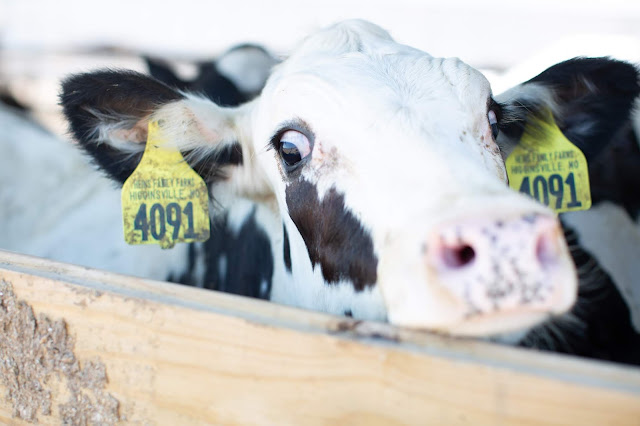
#2780 showing off her best side.

(Let's face it: Every girl has a best side.)


We rounded out the tour with a trip through the commodity shed to see what our cows eat, explain how our nutritionist tweaks the ration, talk about what silage is and discover why it's an important part of a cow's diet.

After that, we headed back to the shop to guzzle a bathtub full of water (Did you know that's about how much water a cow drinks in a day? Almost 35 gallons! And here you thought your eight glasses of water were good . . . ) and enjoy a meal together, surrounded by silage choppers and wrenches and flies because that's what life is like on a real dairy.


Lauren Lane, one of our favorite food bloggers, even made us brownies for dessert, and I'm not saying that I maybe basically skipped lunch and just went straight for the chocolate, but I CAN say that there was one extra pulled pork wrap left over because, well, I maybe basically skipped lunch and just went straight for the chocolate.


Side note: Brownies taste even more fudgy when enjoyed with milk. And because milk is healthy and so wonderfully good for you, you can even have a second brownie if you want. They basically balance each other out.

This is why you need farmers in your life. We can be helpful when you're trying to make important life choices like this. 


We're thankful for our social media influencer friends -- whether they're Instagrammers or bloggers or Facebookers or all of the above -- not just because they took time to come to the farm and see how their food is made, but because as farmers, we're busy . . . you know . . . FARMING. And that means we don't always have a lot of free time to chat with every person in the grocery store or on the street about why dairy is such an affordable, healthy food option.


But people like Cara of Streetsmart Nutrition and Lauren of Lauren Lane Culinarian do. They have the gift of story telling, photography, research and knowing their followers so that they can share information with them in a helpful and winsome way.


 So when a Lauren or a Cara or a Steph of KC Cheeses or Shanna from Wellness for the Win want to know or be reminded of see for themselves where their food comes from, and when, seeing how we care for our animals and land and each other, they believe as strongly as we do about milk and butter and cream and eggs, they help us tell our story in really fun ways.


And we are -- and remain -- grateful for that.


Photos courtesy Wheat Photography


rye silage

Amy Grant may think that Christmas it the most wonderful time of the year, but at the dairy, we think silage chopping time is actually the best!

Or maybe just the most high energy. 

Ok, fine, Amy. You were right all along. But silage is still a pretty sweet time of year, no matter how many CDs you sold!

Where was I? Oh! What is silage? you're wondering. 

It's ok. I was too the first year. Turns out I have this handsome farmer who is happy to explain. Have a read!

Me: What is silage?

Chris: Silage is harvesting and ensiling a forage. 

Me: Wait. What's a forage? Isn't that what dogs do behind dumpsters?

All I Want for Christmas Is . . . Dairy

Anyone else meal planning for the week of Christmas in a semi-frantic state because you just realized that it's Thursday and Christmas is Wednesday and WHAT ARE WE FEEDING ALL THE PEOPLE?

My family always ate chili and oyster stew on Christmas Eve. 

And by "my family," I mean that my mom made oyster stew and my grandparents ate it and thankfully no one asked me to take a bite because there FOR SURE would have been coal in my stocking when I gagged it right back up. 

Oyster stew. Pffff.

Thankfully, Lauren Lane did not serve oyster stew when we gathered at her home a few nights ago. I mean, she probably could have made it and it probably would have even tasted good but let's not take chances, people. I can live dangerously but not like that.  


Instead, she set a beautiful table, kept our wine and water glasses filled, and welcomed us into her home and kitchen with kindness and grace. 

She stirred, and we ate. She plated things, and we dug right in. She cooked, and we felt cared for.


We were quite the crew -- from food bloggers and chefs to dietitians and TV show hosts (and me . . . the farmer . . . except for the part where I just keep the real farmer fed, caffeinated and never lacking for clean work jeans) -- and Lauren kept us all fed, laughing, and oohing and ahhing over her menu, which featured dairy in every course.

 
Yes. You read that correctly. 

Every. 

Course. 

From a gorgonzola souffle . . . 


to ricotta gnocchi with tomato butter sauce and milk-braised pork with herbs . . . 


to a vanilla bean panna cotta with berries, which, to be fair, I would have eaten for every course.


Speaking of meal plans, I've added that panna cotta to our Christmas Day dessert menu because I'm not Scrooge and you won't catch me withholding that deliciousness from anybody.


It was such a treat to meet people who not only eat dairy, but who create recipes that include it, cook with it, encourage others to benefit from its nutritional value, and love it as much as we do.

Look at all that joy right there. It's all from dairy!

Ok, it's really from Lauren's cooking but it included dairy so it's basically the same.

(Good job, cows!)

Frantically meal planning? Take a breath. Our cows have you covered. Step away from the oven. Put down the baking mitts. Lauren's taken care of you for at least one meal with a post on how to host a wine and cheese party perfect for any night of the upcoming 12 days of Christmas.

And while you're pouring that glass of wine and slicing up some delicious cheese, know how grateful we are that you love to drink milk, lick the bottom of your ice cream bowl, and spoon granola over your yogurt.

You're the best.

(Well, actually Lauren's panna cotta is the best, but you're a really close second.)


Merry Christmas! 

baked egg baguettes


I have long contended that being pregnant over Thanksgiving and Christmas is just mean. You go to the doctor's office for your appointment -- having enjoyed all manner of mashed potatoes and pumpkin pie and Christmas cookies and hot chocolate -- and then the nurse asks you to step on the scale. 

Rude. 

At my doctor's office, there's a magical button on the scale that you can push if you want to see what your weight is. Otherwise, the nurse has a readout that you never have to see . . . if in fact you ate an entire batch of snickerdoodles the week before and just don't want to know because the truth is too painful. 


And it is almost always too painful. 

I don't suppose loving bread has anything to do with my fear of the dreaded doctor's office scale. Or my doctor's kind yet ominous threat: "Let's not be eating entire pans of brownies for the rest of this pregnancy, ok? We're just not going to do that." 

Killjoy. 


So for the rest of you who can eat bread and bacon and cheese with reckless abandon, eat an egg baguette for me, would you? Please? 

Or even two if you're feeling charitable? One for the baby, you know.


Beat the eggs, add the cream, stir in the gruyere, slice the baguettes, sprinkle on the bacon, bake them, and then -- better yet -- YOU gain the weight from eating eight of them instead of me. 

Do we have ourselves a deal? I'll just be over here . . . standing on a scale . . . slightly horrified.


Or maybe I'll go ahead and eat one anyway. Not for me, of course. Baby's the one who's hungry.

Yeah.

Baby.


Baked Egg Boats (recipe from Spoon Fork Bacon)

4 demi sourdough baguettes
5 eggs
1/3 cup heavy cream
4 ounces pancetta, finely chopped and fried until crisp
3 ounces gruyere cheese, grated
2 green onions, thinly sliced
salt and pepper to taste


1. Preheat oven to 350 degrees F.
2. Cut a deep “V” through the tops of each baguette until about a 1/2 inch to the bottom. Partially unstuff the baguettes. Set aside.
3. Place the eggs and cream into a mixing bowl and lightly beat together. Whisk in the remaining ingredients and lightly season with salt and pepper.
4. Divide and pour the mixture into each baguette boat and place onto a baking sheet.
5. Bake for 20 to 25 minutes or until golden brown, puffed and set in the center. Season with salt and pepper.
6. Allow to cool for about 5 minutes, cut and serve.


it's always been moo (or why you should give your valentine the gift of raclette aka melted cheese)

Tomorrow is Valentine's Day. You COULD be like every other person out there and buy a giant heart-shaped balloon. Or a $4 card that will get thrown away. Or chocolate that will just make you feel gross after eating 36 pieces of it. 

Or you COULD enjoy a night of raclette with your special someone . . . or a group of single friends . . . or just yourself. 

Raclette isn't picky. Raclette loves everyone. 


Raclette is essentially a Swiss cheese that's known for melting beautifully. In the Alps -- and even in some nicer restaurants in places like New York and Chicago -- entire wheels of cheese are melted and then scraped onto mounds of potatoes and meat, pickles and veggies. 

Let's take a moment to imagine all that melty dairy goodness on your plate.

Ahhhh. 

If, though, your budget doesn't allow you to hop a flight overseas,  you can enjoy raclette at home on Valentine's Day, Christmas Day (as pictured above . . . and below), Tuesday, Saturday, ok, everyday. 

Because my farmer loves meat and vegetables, I gave him a raclette grill for Christmas. (Thank you, Jeff Bezos and Amazon.) It's an eight-person tabletop grill with trays for melting cheese underneath. He's smitten. 

Sometimes with me, but mostly just with raclette. 


Raclette is a perfect dinner party meal, but it's also a lovely meal for two. Because each person is concocting his own series of little meals on the grill, it lends itself to a we're-not-rushing, pour-another-glass-of-wine, enjoy-the-dinner-conversation feel.

It works well for the hostess too, who can prep everything in advance and then set it on the table for guests to dish up as they choose. So far, I've served marinated chicken, shrimp, and beef. I also boil small potatoes and cut them up so that they cook a little faster on the grill. Mushrooms, corn, zucchini, peppers, onions -- you name the veggie and it works for raclette. 

Traditional raclette also usually includes some charcuterie like proscuitto or ham, as well as cornichons. Add some herbs to the mix, set out some olive oil for the grill, and slice up some good melting cheese (Swiss and gruyere work well if you don't have raclette in your area). Cook up your meat and veggies, lay them on some proscuitto, pour your melted cheese over the top, and roll it up like a taco. Or cook some veggies, cover in melted cheese, and scoop up with a cornichon.

Cut up and butter some French bread for toasting on the grill, make a large salad, open a bottle of a dry red wine, and your Valentine will swear off giant teddy bears and red roses forever. 

How can Hallmark compete with you and cheese? Because when it comes to raclette, you'll have him saying, "I'm udderly head over hooves for you" before he puts his second round of veggies on the grill! 

Cheesy, I know. 

(Should I stop now? 

Ok, I'll stop now. 

But seriously, raclette for Valentine's Day! Flowers are so overrated.) 


Mrs. Seifferlein's Baked Oatmeal {Deliciousness}


A couple of months ago, my kind husband told me that Sunday brunch is his favorite meal of the week. Naturally, I took his compliment as a reason to full-on panic.

MUST. MAKE. EVERY. BRUNCH. BETTER. THAN. THE. WEEK. BEFORE.

Of course, what he actually meant was, "I love Sunday brunch because it's the one mid-day meal of the week where I'm not answering 42 phone calls and text messages and having to shovel food in to rush back to the dairy."

But in my people-pleasing panic, I kind of missed that part.

Sunday brunch challenge: accepted.

It took me a couple of weeks of making sweet rolls and frying bacon while giving the baby a bottle and appeasing the toddler with Goldfish before I finally said, "Ok, I give. We have two little kids. I can't make a gourmet brunch and get them fed before 2 in the afternoon."

And in his usual calm way, he said, "Ok."

He's good like that.

So now, instead of trying to make cheesy grits with scallions and spinach/mushroom/ricotta omelets, I'm aiming for two goals: (1) getting lunch on the table quickly so my children don't act like they're about to starve and (2) making it tasty so that it's special for my husband.

That usually works out to scrambled eggs in tortillas (with peppers and sausage and taco sauce and cheese for toppings) or coffee cake and fruit and granola parfaits or 11 pieces of Great Harvest bread delivered from Minnesota to Missouri thanks to my parents.

But this week, we hit the jackpot with my friend Erin's baked oatmeal.

Except she's not your friend. She's my friend. So she's still Mrs. Seifferlein to you.

This met criteria #1 -- I made it the night before and baked it while making the rest of brunch and getting the kids changed out of church clothes -- and #2 because Chris ate three servings.

#winning

Now that we can add another healthy and quick staple to our Sunday brunch, I'm looking for your help.  What are your go-to brunch meals? Bonus points if they make your taste buds happy and your kids don't have to stare longingly out the window wondering where their next meal is.


Baked Oatmeal


2 c. oats
1/2 c. brown sugar
1/3 c. raisins (I omitted these because I don’t like raisins. What did grapes ever do to you, people?!)
1 T. chopped walnuts (I also omit because if I wanted to eat tree bark, I'd go gnaw on my maple in the front yard.)
1 tsp. baking powder
1 1/2 c. milk
1/2 c. applesauce
2 T. melted butter
1 egg, beaten 

(I added a splash of vanilla and some cinnamon as well.)

Preheat oven to 375. Combine ingredients. Spray an 8 inch square pan with cooking spray. Pour into pan and bake for 20-25 minutes. Serve with milk -- because hello! -- and fruit.

Agriculture Grows Families


A couple of months ago, Chris had the opportunity to speak at the Missouri Governor's Conference as a representative of the dairy industry. In honor of National Ag Week, I'm sharing his comments here, as one dairy farmer just telling his story. 

 Hi, I’m Chris. I'm a dairy farmer in Missouri.  My wife and I farm together with my parents.  We milk Holstein cows, farm acres of row crops, in addition to raising about  replacement heifers on local pastures.   Now, my wife, she grew up on a hog farm in northwest Iowa.  So, naturally we never, ever argue about which animal is better…about which animal smells better, looks better, tastes better…
As I was thinking about what I wanted to say here today, my thoughts were drawn to my little 11 month old daughter crawling around and to my wife who is carrying our next child due in March.  And I thought about my great grandfather who lost everything in the Great Depression and about my grandpa who started all over again with nothing.  I thought about the five generations before me who have dairy-ed in Missouri; about the challenges they faced, the opportunities they made, the families they built.  

By nature, agriculture draws families; or better put, agriculture grows families.  As a result, many of us in agriculture have been here in Missouri for generations; perhaps one generation, or three generations or six or more.  And each of those generations have seen their fair share of challenges.  They’ve seen droughts and floods; humid, oppressive summers and icy, bone-chilling winters; blights and insects; weeds and failed crops; and a financial or farm crisis or too.  And yet somehow, here we are today.  
Imagine the challenges that those early settlers of Missouri saw as they came up the river or through the forests.  And yet, they saw the potential, the rough forms, the uncut gems that could be someday.  And in the fields, in the forests, in the pastures, in the barns, they sweated and they bled and they dreamed and they seized the opportunities they were given.  Heck, sometimes they made their own opportunities where there were none and built a rich heritage of agriculture in the process.
 

Those are the stories I think about when I think the challenges and opportunities that face my farm and my family and my dairy.  Are there challenges in the dairy industry?  You bet.  Missouri summers are tough, prices have been low, few members of the workforce have dairy experience, and we don’t have the extent of infrastructure that we used to.   
 But we are not without opportunities.  We have plentiful, high quality feed that’s readily available and affordable:  corn silage, soybean-meal, soybean hulls, distiller’s grains, brewer’s grains, corn gluten, cottonseed, alfalfa, and plentiful pasture land.  We have micro-creameries popping up across the state, reintroducing people to specialty dairy products.   We have a good water supply supported by plentiful rainfall.  In the end, though, it’s not about those physical challenges and opportunities; it’s about how we react to them.  
 

The opportunities afforded us go beyond the physical necessities of dairying.  I find that we have a tremendous opportunity to connect with consumers and to help build consumer confidence.  We have the opportunity to strengthen our social license to operate.  People love dairy cows; they love seeing a calf running through a pasture; they love seeing the care and concern that we have for our animals.  People love the story we have to tell, and they love the way our families are interwoven with our farms.  I strongly believe that this is one opportunity that will have a  positive impact upon our industry for decades to come.
Similarly, we have the opportunity to impact our communities through those employees who work on our farms.  Not only does capital flow back into the local community, but so does character.  I strongly believe dairy farming is character-building work…trust me, I grew up scraping manure and chasing calves.  The character that our employees develop…well, they carry that character and work ethic back into their communities, into their churches, into their families.  As I said before, at its core, agriculture grows families.
 

So both opportunities and real challenges are present.  But if our forebears who settled this state could overcome the mammoth challenges, we can too.  I believe the future can be very bright for Missouri dairy, for those who have the eyes to see the opportunities and the fortitude to capitalize on them.  To quote President-Elect Trump: “If you’re going to think, you might as well start thinking big.”
Each of us up here represents a different industry with different opportunities and different challenges. It’s a pleasure to be a part of that agricultural community here in Missouri, and a pleasure to be with all of you here today. 
Blogging tips