photo blog header_zps71kqewye.png  photo graze_zps8tw4ef8f.png  photo herd_zpsctgnsufk.png  photo farmstead_zpsmyk28rxe.png  photo faith_zpsyq38oy0o.png  photo general store_zpsr2oehrmb.png
Showing posts with label farmers. Show all posts

A Merry Band of Bloggers


My sister lives in Colorado, where the sun always shines and the air is always fresh and the temperature is always just right. So when she visited recently and stepped out of her car, she about fell into a small heap in our driveway because breathing humid Missouri summer air is not for the faint of heart.

Or the faint of hair.


So let's hear it for all the food bloggers and dietitians who willingly volunteered to visit the dairy on a hot, humid Saturday morning, knowing full well what it would do to their hair. I mean, hearts. I mean, heat. It was hot.

Ok. C'mon, guys. Just clap.


(And while you're at it, please give a gentle, quiet "Hooray!" -- we don't want to startle them after all -- for the cows, who start feeling heat stress in about January and don't get a break from it until the following December. Well, not quite. But let's just say they love water misters and fans in the summer as much as kids love a good water park. More maybe.)


Thanks to our friends at Midwest Dairy,  we were able to host these brave blogging souls on a warm day in June, giving them a chance to see where their food comes from up close and personal. Like, so personal a calf could suck on their fingers personal. (Sorry for my white legs. My spiritual gift is getting sunburned without tanning. Clearly.)


Our merry band of bloggers got to see baby calves, only a couple of hours old, and hear from my farmer how we care for the littlest animals on the farm. Between the calves and our multitude of kittens, everybody would have been fine being done at that point.

BUT WE PERSEVERED.


And by that I mean that we kindly nudged them on to meet some of the older heifers and the mama cows who took time out of their lunch to pose for photographs.


#2780 showing off her best side.

(Let's face it: Every girl has a best side.)


We rounded out the tour with a trip through the commodity shed to see what our cows eat, explain how our nutritionist tweaks the ration, talk about what silage is and discover why it's an important part of a cow's diet.

After that, we headed back to the shop to guzzle a bathtub full of water (Did you know that's about how much water a cow drinks in a day? Almost 35 gallons! And here you thought your eight glasses of water were good . . . ) and enjoy a meal together, surrounded by silage choppers and wrenches and flies because that's what life is like on a real dairy.


Lauren Lane, one of our favorite food bloggers, even made us brownies for dessert, and I'm not saying that I maybe basically skipped lunch and just went straight for the chocolate, but I CAN say that there was one extra pulled pork wrap left over because, well, I maybe basically skipped lunch and just went straight for the chocolate.


Side note: Brownies taste even more fudgy when enjoyed with milk. And because milk is healthy and so wonderfully good for you, you can even have a second brownie if you want. They basically balance each other out.

This is why you need farmers in your life. We can be helpful when you're trying to make important life choices like this. 


We're thankful for our social media influencer friends -- whether they're Instagrammers or bloggers or Facebookers or all of the above -- not just because they took time to come to the farm and see how their food is made, but because as farmers, we're busy . . . you know . . . FARMING. And that means we don't always have a lot of free time to chat with every person in the grocery store or on the street about why dairy is such an affordable, healthy food option.


But people like Cara of Streetsmart Nutrition and Lauren of Lauren Lane Culinarian do. They have the gift of story telling, photography, research and knowing their followers so that they can share information with them in a helpful and winsome way.


 So when a Lauren or a Cara or a Steph of KC Cheeses or Shanna from Wellness for the Win want to know or be reminded of see for themselves where their food comes from, and when, seeing how we care for our animals and land and each other, they believe as strongly as we do about milk and butter and cream and eggs, they help us tell our story in really fun ways.


And we are -- and remain -- grateful for that.


Photos courtesy Wheat Photography


rye silage

Amy Grant may think that Christmas it the most wonderful time of the year, but at the dairy, we think silage chopping time is actually the best!

Or maybe just the most high energy. 

Ok, fine, Amy. You were right all along. But silage is still a pretty sweet time of year, no matter how many CDs you sold!

Where was I? Oh! What is silage? you're wondering. 

It's ok. I was too the first year. Turns out I have this handsome farmer who is happy to explain. Have a read!

Me: What is silage?

Chris: Silage is harvesting and ensiling a forage. 

Me: Wait. What's a forage? Isn't that what dogs do behind dumpsters?

Inauguration Day


Let's not get into a Donald Trump vs. Hillary throwdown. That ship sailed November 8.

But let's do talk about the shout-outs that American cattle farmers got on President Trump's inauguration day.


  1. Angus steak was on the menu for the second course of Mr. Trump's first lunch as president. (Granted, the first course included lobster and shrimp, but we won't hold that against him. He is on the East Coast, after all.) And it wasn't just any steak; it was steak smothered in chocolate and potatoes. Be still, my heart. No tofu for this guy. Just straight up beef. I'm in!
  2. The dessert was none other than cherry ice cream. Not frozen yogurt. Not fruit trifles. Ice cream. And we're grateful for the nod to dairy cows; they're part of the fabric of America too. After all, farmers have been milking cows since, well, it's probably safe to assume the Pilgrims got off the Mayflower with a bucket and a two-legged stool in one hand and a lead rope for Bossy in the other, don't you think?
  3. There were tractors in the inaugural parade. Tractors . . . in Washington, D.C., hotbed of taxis and Ubers and Amazon-drones-delivering-groceries. And the parade didn't feature just green tractors. Red, green, blue, yellow . . . they were all represented. That's bipartisanship in farm machinery in action. I vote yes in 2017. 


 I couldn't keep tabs on all the rodeo drill teams and square dancers and pooper scoopers following horses and other country folks that were represented in the parade, but we're grateful for them too.

And for each one of you!

Whether you're eating beef or ice cream in the suburbs tonight, or driving your tractor or milking cows in the country, thanks for supporting America's farmers. We are grateful.

merry Christmas eve

We could say something profound and heartfelt this Christmas Eve, reminding you that a farmer has to "get up before dawn, milk cows, work all day in the fields, milk cows again, eat supper, and then go to town and stay past midnight at a meeting of a school board."
We could remind you that a farmer "has arms strong enough to wrestle a calf and yet gentle enough to deliver his own grandchild; somebody to call hogs, tame cantankerous machinery, come home hungry, have to wait lunch until his wife's done feeding visiting ladies, then tell the ladies to be sure and come back real soon, and mean it." 

rural and small town


Rural life isn't for everybody. And it's not meant to be. Some people are made for eight lanes of traffic, Trader Joe's and lots of coffee availability. 

But some people are made for rural life. Some people are made for gravel roads, the local grocery store with four aisles and a fair amount of, well, dust. 

Or dirt. Or whatever your road is by the time it's gotten worn down by tractor tires. 


In our church denomination, we focus intently on caring for people in rural areas, specifically through Rural & Small Town Mission.

Urban and inner city work is needed and valued, and we spend a lot of time there as well, but we also believe that caring for those on the prairies of the Dakotas or the back roads of Indiana is just as important. 


That's how five future pastors from Concordia Theological Seminary, Fort Wayne, wound up spending several days in rural Missouri, meeting with teachers and bankers, funeral home owners and farmers as part of a Rural & Small Town immersion project. 

Together they discovered what it's like to live and work in rural areas, an exercise that will prepare them--heartily--if they receive a call to small-town Iowa or the hinterlands of Alaska.

Because as I learned from a recent Rural & Small Town conference I attended, Alaska is rural too.

See? Even rural people need to learn about rural-ity.

Rural-ness.

Rural-ocity. 


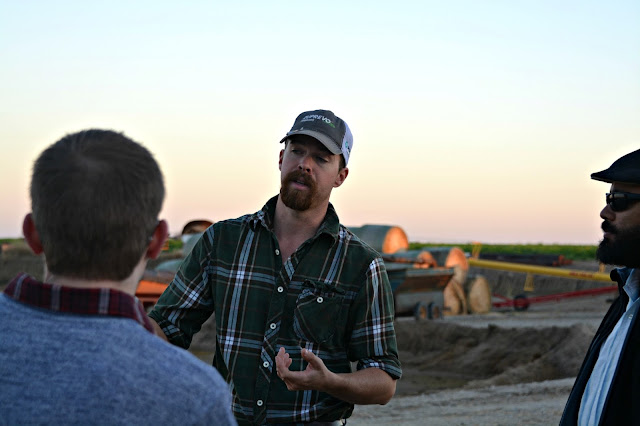
These guys toured our dairy, getting up close and personal with cows and manure and tractors and milking.

And cute farmers with massive goatees who are caught mid-blink.


And then they came to our home for a Fort Wayne style "gemulichkeit" of beer and pretzels before we sat down to break corn bread over chili.

I'm a graduate of Concordia Theological Seminary, and I couldn't have been prouder to see these men taking time away from their studies and families to learn about what makes small towns and rural settings different.

It also didn't hurt to see one of their professors counsel and guide them, rebuke them and teach them, make them laugh and teach them every step of the way. There are teachers, and then, well, there are TEACHERS.


Rural and small-town areas have their challenges, to be sure: skipping church during busy seasons of the year, drug use, poverty, fear of upsetting people you've known for generations, cliques and generations of bad but ingrained habits.

But they have many blessings too: long held morals and values, humor and joy, an appreciation for simple things and the occasional side of beef or deer or box of peaches that gets left on the pastor's doorstep.


The good and the bad, rural and small town: They're precisely why good pastors are needed among them . . . and why we're happy to show off our cows and heat up the soup any old time.


Taran Killam believes "rural = so stupid"


I'm apparently stupid because (a) I'm rural and (b) I have no idea who Taran Killam is, other than that he's a former SNL actor who got flack on election night because he tweeted "rural = so stupid" and then clarified his remark by later tweeting that voting for Donald Trump meant a person was stupid.

Now, Taran.

 Buddy.

I know it was just a little tweet, but I want to clarify something too.

I have two degrees. I use polysyllabic words. I even read The Wall Street Journal every day.

I don't wear bib overalls. I haven't driven around with a dog in the bed of my rusty pick-up, and I've never had Bud Light under a bridge in Daisy Dukes while fishing in the dark.

Or ever actually.

But neither of these sets of characteristics have much to do with being stupid. Just because a person has lots of letters behind his name or an impressive title doesn't mean he's the brightest.

Just because a person has a flashy TV job or a big Twitter following doesn't mean he's the smartest either.

Living in a big city doesn't actually make you a genuis, nor does being progressive or rich or well-traveled.


Plenty of pretty bright people were rural.

Say - oh, I don't know -- George Washington.

Stupidity doesn't come from living in the country. It's a result of failing to engage life or know history, failing to learn from the greats before us or rejecting truth.

Stupidity isn't the result of believing in the Second Amendment, going to church on Sunday and taking walks on gravel roads. Doing loads of my husband's manure-y laundry and owning as many pairs of boots as I do high heels doesn't mean I'm a moron.

Stupidity's a result of thinking small. 


And assuming that because a person lives in a small town or rural setting he's automatically stupid is a pretty myopic view.

I'm not offended by your tweet, Taran. (People use that term way too much in my opinion.)

But I do think you'd be wise to pack up your hatchback and head out of town. Start driving toward Kansas or Iowa or Nebraska. Stop at a farmstead with hog sheds. Pull into a dairy and watch the activity. Con a farmer into giving you a ride in a combine if he's finishing up harvest.

Ask questions. Be inquisitive. Allow curiosity to do its work.

If you do, I'll legit bet the farm you'll discover rural folks aren't stupid just because they're different from you.

And you may -- you just may -- find that you're not as smart as you think either.

Turns out . . . we all have a lot of growing we could do.

Now THAT'S something worth tweeting.


fall weather

The poor weather around here can't make up its mind if it's August or November. 

One day it's 80. The next it's 60. 

My immune system doesn't know if it should ramp up or give up. 

Our Great Pyrenees comes out from the shade of the deck only to turn around and go right back under. 


Not that we're complaining. 

Warm days mean walks on our gravel road and windows open at night to let the cool breeze in. 

It means happy cows and the chance to finish extra projects outside before the snow flies. 

It means a lovely combination of cold peach tea and hot cocoa . . . all in the same day! 


It means trips back to Iowa and to the pumpkin patch, 

sunrises and earlier sunsets, 

fat pumpkins and warm soups and big salads. 

Before we know it, Jack Frost will decorate the windows and farmers will be wearing flannels and vests. 


So for now, we're enjoying the dust whipping up on the gravel roads, planning Thanksgiving meals, pureeing pumpkin from the garden, and the crisp, sweet snap of the first of the pomegranates from the grocery store. 

How are you enjoying this beautiful fall weather? 


this is going to be the year


That's my go-to phrase regarding our garden pretty much every year: This is going to be the year! 

Let's just say: Hope springs eternal when it comes to our garden. 


Year 1 wasn't so bad. I maybesortakinda let the weeds get a little out of control. Ok, so we had to use the weed whacker at one point. But isn't that its job?! To whack weeds?


Year 2 was just a mess. Don't let the little surprise pictured above fool you. (Somebody found that in a bunch of trees and thought it would be funny to scare the living daylights out of me...and it worked.) It rained for roughly SEVEN THOUSAND WEEKS IN A ROW so nothing grew, and the sad little tomato plants that did survive only produced about a half a tomato a piece. I gave up part way through the summer. 


But every year, I tell myself it's going to be different this time around. And this year, I'm happy to report, it has been. 

For a solid two weeks now.


And by that I mean: the garden still has discernible rows, which is a small victory for me. 

I also planted -- and have managed not to kill -- two lilac bushes, because lilacs are my favorite flower in the entire world. My parents have a 1/10 mile stretch of them, and my favorite time of year is when they're all blooming and the air smells sweet. 

My sisters and I would pick them for our mom, and even though they only last about 12 seconds before the petals started falling off, we loved them. Our dad would go with us out into the pine trees and lilac bushes and help us pick some. He'd lift us up so we could see into the branches of the pine tree where robins built nests, and we'd count the little blue eggs. Good memories go hand-in-hand with lilacs.


And these beauties, even though they're annuals, survived the winter and bloomed again this spring, which is basically like Christmas in May.

Back home in Iowa, humans are lucky to survive the winter, let alone plants. Living farther south has its perks!


Also, little known fact: When you have dogs, also get fences for your garden. Lots and lots of fences. Unless you're into having them dig up your carrots before your carrots even know they're carrots.


See that face? That is the face of a pup who knows not to dig up a carrot.

It's not, consequently, the face of a  dog who knows to leave chickens alone or not to pull out their tail feathers, but heck, we can't have it all.


This may be the year. It may not. But for now, the farmer and I are spending 10 or 15 minutes here or there pulling weeds and grass, attempting to not let the garden tend toward chaos, even though it wants to.

Let's reconvene in August, and I'll let you know how those carrots, spinach, lettuce, sweet potatoes, corn, tomatoes, peppers, peas and watermelon worked out.


Or maybe not. History has a way of repeating itself, you know.

radishes


You know those pictures of rows and rows of colorful tulips in Holland? This is like the Missouri version of that. Except it's radishes. 

Confused? Me too. 


Good news! My farmer isn't. 

Me: Can you tell our nice readers what normally grows in this field?
Him while eating popcorn and reading a book on the Texas Rangers: Rye. 
Me: Which is fed to . . . 
Him: Heifers mainly. 

Me: Why do you plant radishes?

Him without looking up: We plant them in the fall for additional grazing for the cows and for soil health. They help the soil by putting down a thick root that breaks up soil compaction. 

Him pausing for a bite of apple: They're also good at gathering nutrients that the next year's crop can use. They are better nutrient scavengers than corn and soybeans. 


Me: Why are they flowering now?

Him:  They didn't die over winter like they normally do because it was pretty mild. Radishes, like lettuce and peas and others, if left to go long enough will flower and bolt and go to seed. We actually don't want them growing in the spring because by the time the rye is ready to chop, they'll be too mature and they won't be as high quality feed. 

Me: But they're so pretty!
Him: Next question. 


Me: Ahem. Right. So what's the purple stuff?
Him: Henbit. It's a weed that grows in late winter and early spring and usually dies off by the time that crops are growing. 

Me: Wait. I wasn't done with the radishes. Why are they the most disliked of the veggie tray?
Him: I don't answer ridiculous questions. 
Me: So . . . we're done here?
Him: *silence*

anti-GMO cruelty

Adapted from after-dinner remarks by Purdue University President Mitchell E. Daniels Jr.at the Agriculture Department’s Agricultural Outlook Forum in Arlington, Va., Feb. 25:

There are huge threats, impediments, to our climbing the mountain of feeding a world of nine billion fellow humans, but they are not the ones we’ve known in the past.


The threat this time is internal. It will be a self-inflicted wound. What is troubling me, and I hope troubles you, is that there is a shockingly broad, and so far shockingly successful, movement that threatens this important ascent of humankind out of the condition that has plagued us since we first walked upright: of having enough food to meet the most basic, the most elementary need of any living species. That threatens our ascent by choking off the very technologies that could make that next great triumph possible.

I suggest to you that you have a positive duty to do things that probably do not come naturally, to contest and refute junk science and false claims against the technologies that offer so much promise to the world. And not solely on the polite objective grounds that come most naturally to folks in the pursuits represented here, to people who work in the regulation of agriculture and its products, to those who study academically these subjects and work on the new technologies and the policies around them, or to the businesses that produce these products as the technologies become available. . . . 


Marie Antoinette may have at least had the excuse of naïveté and ignorance. That excuse cannot be made for the people who are attacking GMOs and other technologies like that today. You know, when starvation was imposed knowingly, in cases and instances we can all think of from the past, we knew what to call it. And I can’t for the life of me see a moral distinction between those instances and these.

Read Mr. Daniels' comments in full from the Wall Street Journal here

dads


I'm a firm believer that children need a mom and a dad. 

Certainly there are cases where the mom is left on her own, or where the dad shirks his duty and takes off, or where the dad has passed away. 

But I'm not talking the exceptions. 

I'm talking the rule. 

I know how much I need my dad . . . and I'm 31. 

And I know that Georgia already recognizes her dad and responds to him with smiles and toots and big eyes.

She knows her dad because he's here.  

Because he sings to her. 

He reads to her. 

He prays over and for her. 

He tickles her. 

He smooches her. 

He takes her to church. 

He keeps her safe. 

He comforts her. 

He snuggles her. 

He explains things to her. 

He tells her about her future. 

He describes the puppies and the cows and the chickens to her. 

He works long, hard hours so that her mom can stay home with her. 

He tells her about Jesus and politics and land prices and farm markets and how to build fence and dig tile and why Lent matters. 

And he always has a smile and a kiss for her when he comes in, even after working a 21-hour day. 

I can feed her and change her diaper. 

But she needs her dad. 

And I'm glad the Lord blessed her with this one. 


PHOTO COURTESY KATIE LOCKHART PHOTOGRAPHY 

oh dear


It turns out that our Great Pyrenees - Petunia - has been, uh, KNOWN. 


In the biblical sense. 

Ahem. 


To make this even more complicated . . . our first Great Pyr, Wally, got the neighbor's lab pregnant. Then he got run over. 

So we got a second Great Pyr . . . the exact same day the neighbor asked us to take two of the lab's puppies. 

One was Wally's protege and one was their Shar Pei's offspring. 

That's correct. 

We ended up with three puppies in one day. It was also the day we told our parents we were having a baby. 

Like I said . . . oh dear. 


Now Petunia is pregnant . . . perhaps with Wally's son's baby or perhaps with our black lab Blackjack's pups. 

Can someone please cue the Lion King's Circle of Life? 


In any case, if you're in Missouri and are on the lookout for a 3/4 Great Pyr -- or perhaps a half Great Pyr, half lab -- give us a shout-out. Petunia, like State Farm, has got you covered. 


Blogging tips